QSOs in October 2020: MS in red, FT8 in green and SSB in blue
While refurbishing our irish home, I found some time in the mornings and the evenings to be active on 2 m. At least I worked 31 squares. Even on 23 cm I got 3 Calls to the log. The rig so far is an IC-9700 with a 7 element yagi and a linear amplifier with 200 W on 2 m and a 69 element yagi on 23 cm,
Now I have to close the station and take the antennas down. It has been a lot of fun and I hopefully will be back next year, if pandemic allows. Many ideas are in my mind now, how to improve the station over here.
Many thanks to Joe, EI3IX, his N adapter female-female allowed me, to run 2 m and 23 cm simultaneously 😉 .
As some work at our families house in Ireland has to be done, I am spending 3 weeks over here in IO53HN. I got my new IC-9700 with me and have antennas for 2 m and 23 cm. As I have to restrict my movements by government order, no portable activites are possible in the first two weeks. So I will try to work in the UHF/SHF Contest on 23 cm from the southern lake shore of Lough Mask. My favourite direction is to GI/GM. Maybe I can go to a better QTH later in the 23 cm UKAC. On 144 MHz I will focus on meteor scatter in the morning hours.
In a first test on 2 m I worked GI and GM in FT8. GM7PKT came back on my very first CQ. Later I tried meteor scatter with my german neighbour Mathias, DH4FAJ. As he has massive QRM, he couldn´t hear anything, but I copied him twice with +4 dB. So better to try in the morning again.
A question in a Facebook group about a GPDSO for an IC-9700 to be used on 23 cm for FT8 inspired me for a quick test. As I use my IC-9700 for 2 m and 70 cm only from home, I connected a dummy load to the 23 cm antenna socket. Next was to tune it to 1,296.174 MHz (of course) and to call in FT8.
The result in brief: No problem to decode with my regular 23 cm rig (OCXO controlled). Just a moderate drift and the signal appeared about 100 Hz too low. Nothing to worry about.
But never the less, I prefer JT9f on 23 cm, as FT8 is useless on aircraft scatter.
A nice inversion could be seen out of the window of my shack this morning, promising good conditions. In fact I have been a little too far south for the duct, but at least I had two QSOs to Belarus in FT8.
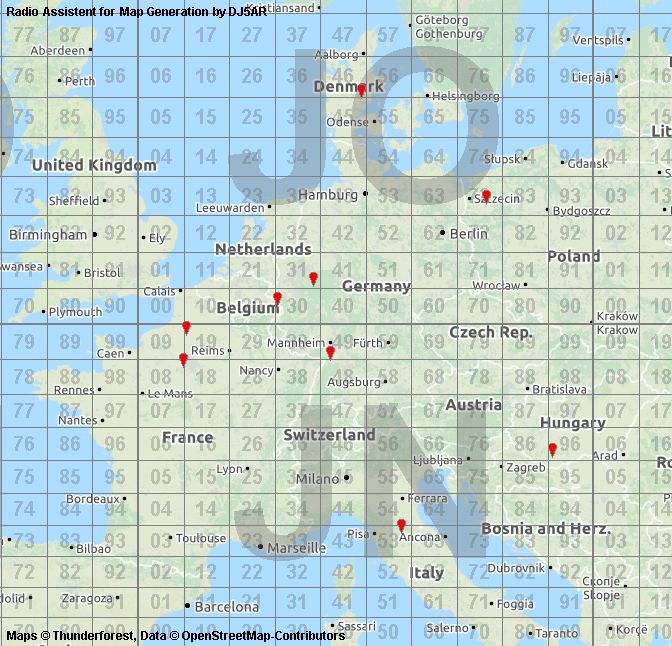
Green: worked – Red: heard via tropo – Blue: heard via meteor scatter
The stations worked and heard via tropo have been in distances up to 1300 km. Occasionally signals appeared from more distant stations, 1500 and more km away. These could be decoded in one or two periods, then disappeared. Some reappeared later in the same manner, so it´s very likely, it has been meteor scatter, as it happened in the early morning, when conditions are good for sporadic meteors.
It was nice to paricipate in the recent Microwave Contest on first weekend in June. There was a lot of activity despite the fact, no multi operator stations have been there as big guns. Meanwhile the claimed scores for DL are available and I was surprised by looking at the number of german participants on the 23 cm band. 174 stations sent their logs, which is much more than the total numbers of single and multi operator stations in the past years.
So I guess, it may be caused by the popularity of the new ICOM IC-9700 SDR transceiver, covering the 23 cm band.
Addendum June 17th, 2020: Pit, DK3WE, the contest manager, had a look for me at the .EDI files and found among those, who entered the equipment, 40 entries of IC-9700.
I have been curious about everything about the hydrogen line for quite a while. So at least I mounted a feed for 1.4 GHz in my 3 m dish, installed a LNA at the feed, as well as a Pluto SDR and SDR# with the IF-Average plugin. First steps are very promising, as I saw something, when beaming to Cassiopeia and Swan.
Cassiopeia
Swan
Due to the doppler shifted signals the lines are smeared (red marks). The spikes seen, are just interferences.
The VHF/UHF/SHF contest on 2nd to 3rd of May was a good opportunity to spend a few hours trying the new AirScout version 1.3.3.0 released by Frank, DL2ALF. In principle it works like it´s predecessors, but is more stable in collecting the aircraft data. My favourite in this case is planefinder.net.
Most impressed I am by the new feature to monitor a number of paths to certain stations simultaneously! This provides more efficiency in arranging skeds, particularly in times like these, when there are a few planes only are available.
I got up quite early today and decided to check the beacons on 23 cm. When beaming to LA1UHG, there was a noticeable signal in F1 about 1 kHz above its frequency. It was easy to read it as DB0LB from the back of the dish. But it seemed, there was another faint signal right beside the spacing carrier. With the help of my SDR radio I could set very narrow filters and after a while of listening, I identified it as LA1UHG, JO59FB, 1028 km. Wow!
But the signal faded out more and more and at least it disappeared.
LA1UHG just 140 Hz below the space carrier of DB0LB
Later this morning, the dish still pointing north, I heard Kurt, OE5XBL, chatting in SSB with Rudi, OE5VRL/5, both with very strong signals on 23 cm. Expecting a huge signal, I turned the antenna to Kurt, but there was no significant increase in signal strength. I called in and the three of us were talking about the conditions and to meet for a beer at the GHz convention in Dorsten next February, when Kurt was called by Dave, G4RQI. I had tried with him earlier without any success, and so, to be honest, I was a little annoyed by this. Even, when turning the dish to the UK, I couldn´t copy anything of Dave’s transmissions, while he was working Kurt and Rudi. These were enough indications, that the inversion was at a too high altitude for me, to enter it. So I went for a long walk with my XYL in the nearby vineyards.
The inversion is at an altitude of about 1000 m (Courtesy DWD)
In the evening I performed another beacon check. It was funny to see beacons, the dish was pointing to, as well as others from the back of the dish
Dish pointing southeast: DB0UX, DB0VC, DB0AAT (from left to right)
Turning the dish, confirmed the experience I had in the the morning: Pointing southeast I saw DB0VC, JO54IF, next to DB0AAT, JN67HU. Turning the dish towards Kiel in the north, the signal of DB0VC increased just a little. Maybe, it has been reflected by a mountain range about 50 km southeast of me.
Dish pointing north: DB0UX, DB0XY, DB0VC, OZ7IGY (from left to right)
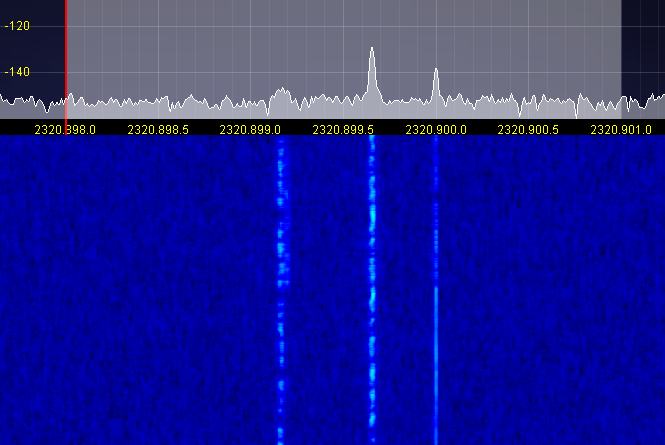
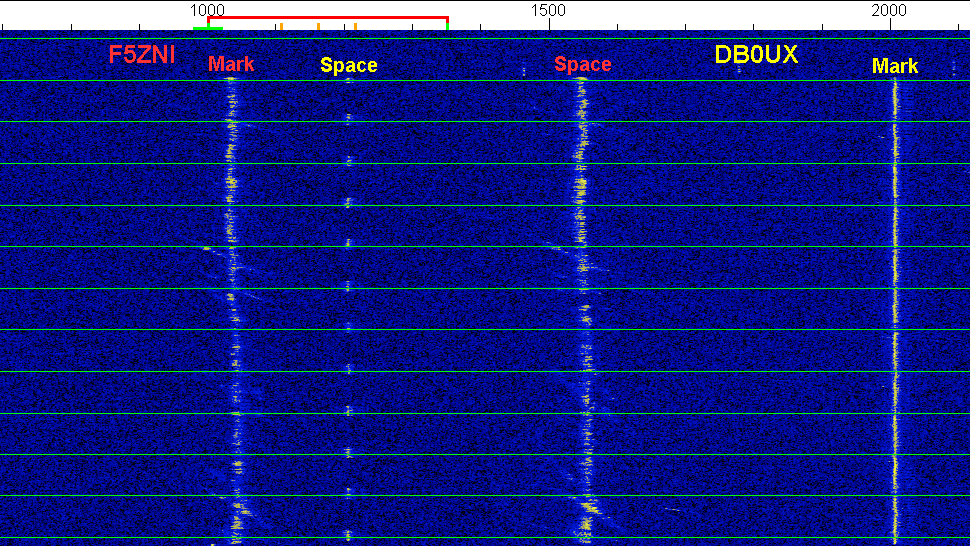
By performing my daily beacon check, I noticed a weak keyed carrier in between the spacing of the F1 signal of DB0UX on 2320.900 MHz. I assumed to see F6DWG/B, which I monitored around the .900 before. But it didn´t take long to find out, that the real signal (mark) was the lower carrier and after a while I learned, it was F5ZNI using reverse F1 keying. Later in the evening the signal increased due to good tropo conditions, as can be seen in the pictures. F5ZNI is the 34th beacon I received in the 13 cm (S) Band
F5ZNI and DB0UX in PowerSDR
I am always happy about new beacons, but this case is an example, why beacon coordination and using standards is most important. First of all, reverse F1 keying is always bad, as you are used to listen to the upper carrier of the signal. In case there is an unkeyed carrier in between the text, you can easily identify the mark, where to listen. But if there is text keyed nearly all the time, as F5ZNI does, it is rather time consuming until the mark is identified.
The DB0UX signal was strong and the frequency is locked to a reference, while F5ZNI is drifting a little. So it was obvious, that there was a second signal in place. If the french beacon would have been locked to 2320.900 MHz too and would use the standard A1 or F1 keying, there would have been no chance for me to monitor or even to take notice of it.
An excerpt from BEACONSPOT.UK shows the situation on 2320.900 MHz:
Beacon
Nominal Frequency
Locator
Last Spotted
Last Frequency
Status
F6DWG
2320.900
JN19BQ
2019-05-31
2320.898
Dead/lost
HG3BUC
2320.900
JN96CC
2019-10-11
2320.897
Operational
OZ5SHF
2320.900
JO45VX
2019-08-24
2320.900
Operational on spot date
DB0MJ
2320.900
JO31UB
2019-12-29
2320.905
Operational
ON0TB
2320.900
JO30BM
2019-09-20
2320.897
Dead/lost
DB0UX
2320.900
JN48FX
2019-12-29
2320.900
Operational on spot date
F1ZCC
2320.900
JN08XS
Uncertain - new spot required
SR1SHS
2320.900
JO73PG
2019-12-30
2320.900
Operational
IQ5FI
2320.903
JN53SR
2019-12-28
2320.901
Operational
F5ZNI
2320.904
JN19BQ
2019-12-30
2320.899
Operational on spot date
Depending on the location and the conditions, there will be more or less interference on 230.900 MHz
As the beacon keeper Thomas, DL4EAU, wrote me, the DB0XY beacons in JO51EU are back on air. The frequencies are 1296.912, 2320.912 and 10368.912 MHz. All are locked to a GPS reference now.
DB0XY on 1296.912 MHz in JN49CV: A weak tropo trace, but many nice reflections on airplanesDB0XY on 2320.912 MHz: No trace via tropo, but many reflections on planes